5 web dev trends we're paying attention to in 2026
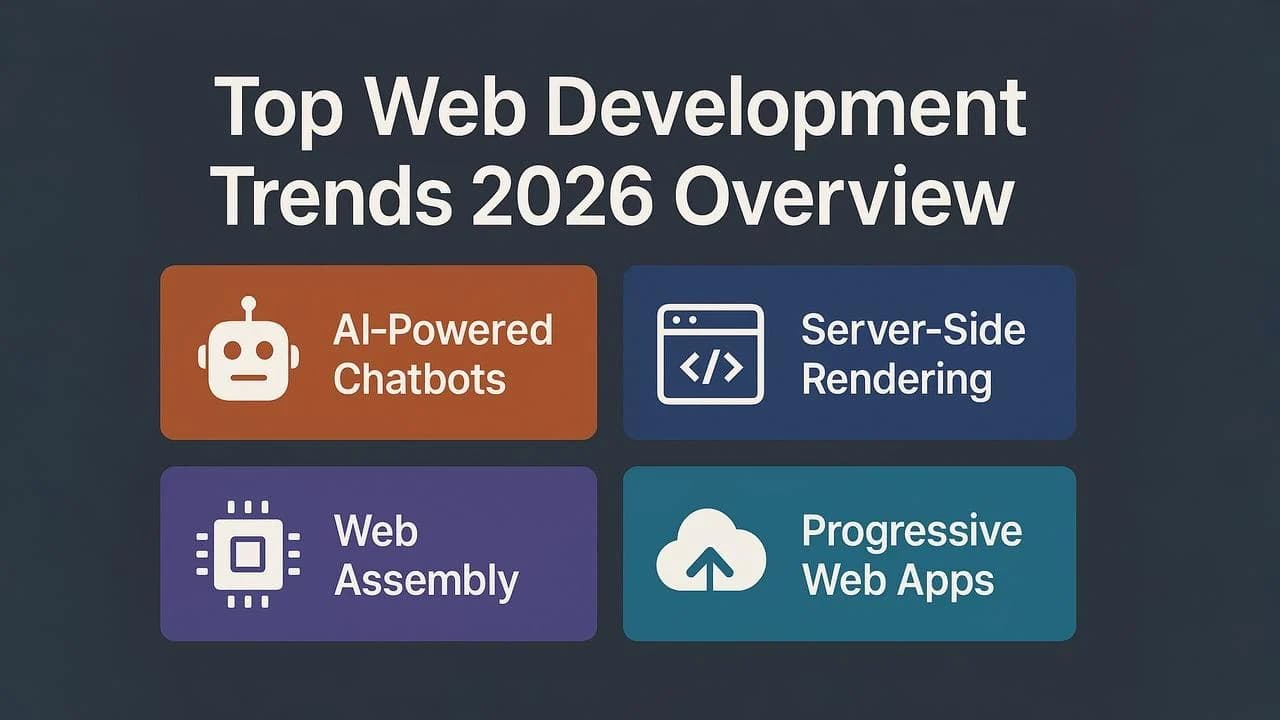
TL;DR
- AI-assisted development is real and useful — it's making good developers 30-40% faster, not replacing them
- Server components (React 19) changed how we think about data loading and page performance
- Edge computing moved from buzzword to default — your site now runs from the server closest to each visitor
- Structured data and AI-readable content are the new SEO battleground
- The no-code/custom-code gap is closing, but the middle ground is where most projects land
Trends lists are usually garbage. "Blockchain will disrupt web development!" "The metaverse will change everything!" Thanks, 2022. Very helpful.
This list is different because we're not speculating. We're a three-person web development team that ships sites every month. These are the five trends that are actually changing our work right now, in early 2026.
1. AI-assisted development is here — and it's not what you think
The conversation about AI in web development has been weirdly binary. Either "AI will replace all developers" or "AI is useless, real developers don't need it." Both takes are wrong.
The reality is simpler than either camp admits: AI tools like Claude Code, Cursor, and GitHub Copilot are making experienced developers faster. Not by replacing their judgment, but by handling the repetitive parts of the job — boilerplate code, test generation, debugging obvious errors, documenting functions.
Developers who use AI assistance consistently report being 30-40% faster on routine tasks. But — and this is the important part — that speedup only applies when the developer using the tool knows what good code looks like. AI tools suggest things confidently even when they're wrong. You need the experience to catch the mistakes.
The practical impact for businesses: development timelines are getting shorter, and experienced developers can take on more work. But the "hire a non-developer and give them AI tools" approach is still producing bad results. AI-generated sites often look fine on the surface and fall apart the moment anyone tries to maintain them.
Our take: AI makes the floor higher and the ceiling higher too. Good teams get better. Bad teams get faster at producing bad work.
2. React server components changed the game
React 19's server components aren't new anymore, but their impact is still unfolding. If you're not a developer, here's why this matters to you: your website can now be significantly faster without any compromise on functionality.
The old React model: your browser downloads JavaScript, executes it, then fetches data, then renders the page. Lots of round trips. Lots of waiting. The new model: the server does the heavy lifting and sends ready-to-display HTML to the browser. JavaScript is only downloaded for the parts that actually need interactivity.
The numbers are dramatic. When a traditional React SPA gets rebuilt as a Next.js 15 app with server components, you typically see Time to First Contentful Paint drop from 2-3 seconds to under 1 second. Total JavaScript shipped to the browser can shrink by 60-80%. Google PageSpeed scores regularly jump 30+ points.
For business owners, this translates to better Google rankings (Core Web Vitals are a ranking factor), lower bounce rates (users don't wait for slow pages), and better conversion rates. Studies consistently show that every 100ms of improvement in page load time increases conversion by 1-2%.
If your site was built before 2025 and uses React or a similar framework, it's probably leaving performance on the table. Worth a conversation with your developer about what a server component migration would look like.
3. Edge computing went from buzzword to default
Remember when "cloud computing" was a trend? Now it's just... how things work. Edge computing is making the same transition.
The basic idea: instead of your website running on a server in Virginia and being slow for users in Tokyo, it runs on servers everywhere. Each visitor gets served from the server closest to them. Your site in Virginia, your site in Tokyo, your site in London — all at once.
Platforms like Vercel, Cloudflare, and Netlify made this the default deployment model. When we deploy a Next.js site to Vercel, it's automatically available on 100+ edge locations worldwide. No configuration, no extra cost for the basic tier.
Why this matters right now: global audiences are the norm, not the exception. Even a small business in Sofia gets visitors from the US, UK, and EU. With edge computing, those visitors all get fast page loads regardless of geography.
The tooling caught up too. Edge functions can now handle database queries, authentication, and API calls — tasks that used to require a traditional server. Things like contact form processing, newsletter signups, and analytics tracking all run perfectly on edge functions. Zero cold start time, 20ms response times globally.
If your hosting bill includes words like "dedicated server" or "managed VPS," it might be time to look at what modern edge-first deployment looks like. The performance difference is often dramatic, and the cost is usually lower.
4. Structured data is the new SEO
This trend is quietly massive. The way people find information online is shifting. Traditional Google search is still dominant, but AI-powered answer engines — ChatGPT search, Perplexity, Google AI Overviews — are growing fast.
These AI engines don't just crawl your page and match keywords. They try to understand what your page is about, extract specific facts, and cite you in their answers. The sites that do this well get referenced. The ones that don't get ignored.
What makes your site AI-readable:
- Schema.org structured data — JSON-LD markup that tells search engines exactly what your page contains. Product prices, business hours, FAQ answers, article authors, review ratings. The more structured data you have, the more AI engines can cite you accurately.
- Clean heading hierarchy — h1 for the page title, h2 for sections, h3 for subsections. AI engines use this to understand page structure.
- Question-answer format — pages that ask a question in a heading and answer it in the body text match the query patterns that AI engines process.
- Specific, citable facts — "Our landing pages start from $2,000" is more useful to an AI engine than "competitive pricing." Numbers, dates, and concrete claims get cited. Vague statements don't.
- An llms.txt file — a machine-readable summary of your site, similar to robots.txt but designed for AI crawlers. We've started adding these to every site we build.
Traditional SEO isn't dead. But optimizing only for Google's traditional algorithm means you're missing the AI-driven traffic that's growing month over month. We now include structured data setup and AI-readability optimization in every project we build.
5. The no-code/custom-code convergence
The "no-code vs. custom code" debate has been going on for years. In 2026, the debate is becoming irrelevant because the two worlds are merging.
Webflow now supports custom code components embedded within its visual builder. Shopify's theme architecture allows deep customization without abandoning the admin interface. WordPress with headless CMS setups gives you full React freedom with WordPress content management.
What this means in practice: most projects don't need to be "no-code" or "custom code." They land somewhere in the middle. A marketing site built in Webflow with a custom API integration for pricing calculations. A Shopify store with a custom-built product configurator. A Next.js app with a Sanity CMS backend that non-developers can manage.
The question isn't "should we use no-code or custom code?" anymore. It's "which parts of this project need custom development, and which parts are better handled by a platform?" The answer is usually a mix.
For business owners, this is good news. It means you're not locked into one approach. You can start with a platform-based site that's fast to build and affordable, then add custom functionality as your needs grow. The upgrade path is smoother than it's ever been.
What we're watching but not betting on yet
A few things that might make this list in 2027 but aren't there yet: Web3 identity (still too complex for mainstream), AR/VR web experiences (cool demos, no real demand), and voice-first interfaces (limited use cases outside accessibility). We're keeping an eye on all three, but none of them are changing how we build sites today.
The five trends above? They're not future predictions. They're what we're building with right now. If any of them are relevant to your business and you want to talk through what they'd look like for your site, that's what we're here for.
Keep reading
Is OpenClaw actually useful, or just hype?
Everyone's talking about OpenClaw. We spent a week building with it to figure out if it's worth the buzz — or if it's another tool that sounds better in a demo than in production.
Webflow's 2026 updates: the good, the meh, and the missing
Webflow shipped a lot this year. New CMS features, AI tools, localization, and a reworked editor. Some of it's great. Some of it's half-baked.
Shopify Winter '26: 150 updates, 7 worth knowing
Shopify dropped 150+ updates in their Winter '26 Edition. Most of them you'll never notice. Here are the 7 that'll actually change how you run your store.